
Client Background
A service-focused operator was running a busy call center and capturing thousands of recorded calls every month. On paper, they were "data rich." In reality, they had almost no practical insight into what was actually happening on those calls.
Supervisors were operating on instinct. Customers were getting frustrated. Leaders kept asking the same questions without real answers:
- Why are people calling?
- Where are they getting stuck?
- Which issues are consuming the most time?
- What's causing the most reputational damage?
- How are our representatives really performing beyond anecdotes?
They evaluated several commercial products and gathered proposals from others. The pattern was familiar:
- Some tools were expensive and required long contracts.
- Others were rigid, forcing them into generic analytic templates.
- Many required cloud uploads, which was a non-starter for calls containing sensitive customer information.
Most importantly, none of the tools answered the specific operational questions the client cared about.
So they engaged BuildClub Professional Services to stop searching for the perfect product and instead build the tool they actually needed.
The Problem: Insights Locked Inside Thousands of Calls
At a high level, the client's challenge looked simple:
"We have thousands of calls, but we don't know what they're really about."
Under the surface, the constraints were real:
- Sensitive information meant strict data privacy requirements.
- They wanted to run everything locally, on their own hardware.
- Leadership needed simple, actionable outputs, not dashboards full of noise.
- Supervisors needed to query calls in plain language, not learn complex BI tools.
Off-the-shelf solutions tried to solve "analytics for every call center." The client needed analytics for their specific call center, with their patterns, customers, and risks.
Why the Client Engaged BuildClub
The client's ask to BuildClub Professional Services boiled down to:
- Give us clarity on why people are calling and where they're getting stuck.
- Keep all data local — no cloud uploads, no external processing.
- Make it fast and lightweight, so supervisors will actually use it.
- Build it quickly and show us how to operate it ourselves.
BuildClub's role:
- Architect a minimal but powerful call intelligence workflow
- Use modern LLMs and local models to do the heavy lifting
- Implement a simple interface suitable for real-world supervisors
- Deliver the first version in a day and leave the client with a tool they can own
BuildClub's Approach: LLMs as an Application Co-Developer
This was not treated as a big "software project." There was no new dev team, no months-long backlog.
Instead, BuildClub Professional Services:
- Used Cursor as the development environment
- Paired Cursor with Claude and other LLMs as co-developers
- Had a BuildClub engineer orchestrate the design, validation, and integration
The models helped generate the application interface, sequencing and workflow logic, file handling and batch processing code, and the orchestration layer that ties everything together.
On top of that, the system integrated two local AI components:
- Whisper (local) for fast, private transcription
- Mistral (local) for summarization, topic extraction, sentiment analysis, and insights
Everything runs on a standard gaming PC — no special hardware or GPU clusters required.
The AI Intern: A Manager's On-Demand Analyst
One feature quickly became the centerpiece of the implementation: the AI Intern.
For every call, supervisors and leaders can now ask natural-language questions like:
- What was the customer trying to do?
- Was the caller frustrated or calm?
- Is this issue trending more than usual?
- Did this call create reputational risk?
- Are we spending too much time on this topic?
The system responds in plain language, almost instantly. Instead of manually listening to hundreds of recordings, supervisors can explore an entire week of calls in minutes.
It feels like handing each manager a patient, tireless assistant who never gets bored, never forgets details, and can instantly cross-reference themes across dozens or hundreds of conversations.
BuildClub designed the AI Intern layer so that it sits on top of structured outputs (transcripts, summaries, topics) and uses local models to answer free-form questions without sending a single sentence to the cloud.
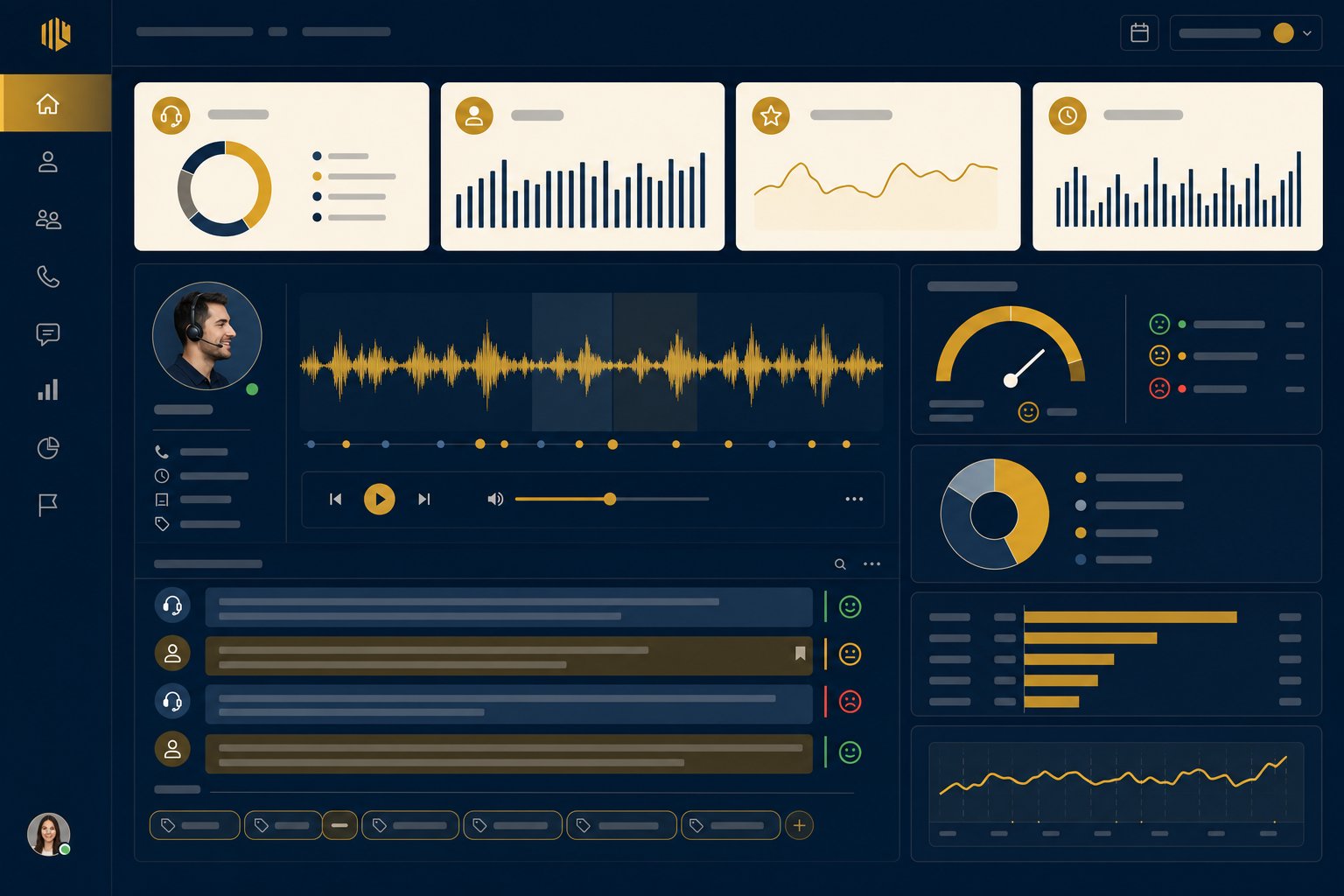
A Simple Interface with Serious Output
Because the tool was built specifically for this client, the interface is intentionally simple and focused on their workflow.
Core user experience:
- Drag in audio files (or point to a folder)
- Choose an output directory
- Click "Start"
Behind that simple flow, the tool processes roughly 1,000 calls per hour on standard hardware and generates full transcripts for every call, clean summaries, identified topics and categories, sentiment and escalation signals, reputational risk flags, call duration and basic metadata, and representative-level performance patterns.
Everything operates locally: audio files stay on the client's network, models run on their own equipment, no third-party uploads.
Advanced Controls for Power Users
For analysts and technically curious staff, BuildClub added an advanced settings panel: adjust model parameters and thresholds, modify prompt templates and summary formats, plug in new local or Hugging Face models without rewriting core code.
The Biggest Insight: A Problem Nobody Realized Was Huge
When BuildClub helped run the first full week of calls through the system, one pattern jumped out immediately.
Half of all call center time was being consumed by a single issue that almost nobody thought was important.
- It wasn't highlighted on any dashboard.
- It wasn't a major part of training.
- It wasn't on leadership's radar as a high-impact problem.
But once the transcripts were structured, the summaries grouped, and the topics counted and compared, the trend was undeniable. This "unimportant" topic was eating a massive share of staff time and generating recurring customer frustration.
That one discovery triggered immediate changes in training priorities, staffing and escalation paths, and proactive customer messaging.
The client is clear: they would never have uncovered this with manual spot checks or generic reports. It took building their own intelligence tool to see it.
BuildClub's Role and the One-Day Timeline
From start to finish:
Morning: Clarified operational questions and privacy constraints. Sketched the ideal outputs and workflow. Set up the development environment with Cursor and local models.
Midday: LLM-assisted generation of the interface, file pipeline, and orchestration code. Integration of Whisper for local transcription. Integration of Mistral for local analysis and the AI Intern layer.
Afternoon: Test runs on a sample set of calls. Tuning of topics, summaries, and sentiment tags. Creation of the structured export and spreadsheet outputs.
Afterward (light iteration): UI polishing and small workflow tweaks. Documentation and a short training session for supervisors. Hand-off with a simple runbook and configuration guide.
In total: a few hours to get the first working version, one day of refinement to make it production-ready for internal use.
Final Thought
The client didn't set out to build a new platform. They set out to answer their own questions: What are our customers really experiencing? What are our teams really spending time on? Where are we at risk, and where are we blind?
With BuildClub Professional Services and modern language models, a few hours of focused work and a single day of iteration produced a private, local call intelligence tool, a durable AI Intern supervisors can talk to in plain language, and insights that materially changed how they train, staff, and serve customers.
It improved their operation almost immediately. And it cost little more than curiosity, a normal gaming computer, and the willingness to build instead of waiting for the perfect product to appear.
Sometimes the most powerful transformation in a call center doesn't come from a vendor brochure. It comes from deciding to build the tool that finally tells you what's really happening on your own phones.
Want help with something similar? Talk to us →
We work with operators, PE-backed businesses, and professional services firms to ship outcomes — not decks.