
PHASE 2 · WORKFORCE
Hire your first digital employee.
A digital employee that performs a defined role inside your company — an Outbound SDR, a Finance Close analyst, a Tier-1 support rep. Trained against your real workflows. Two ways to engage: Build it once and you own it, or Managed and we run it on outcome-based pricing.
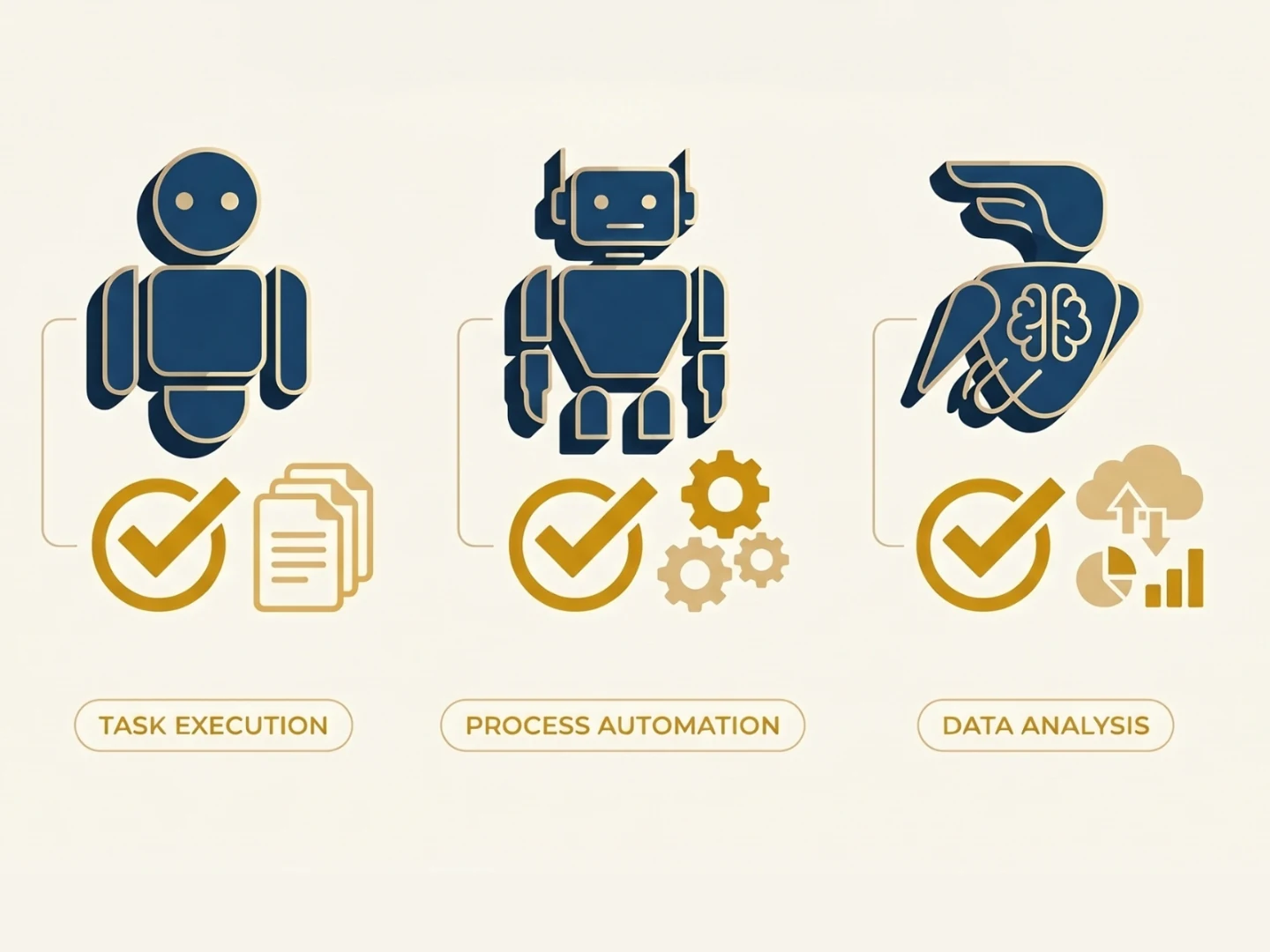
How a digital employee works
Scoping
We define the role: tasks, inputs, outputs, decision authority, escalation rules. We measure baseline output.
Training
The agent runs in shadow mode against your real workflows. Human reviews every action. We refine prompts, tools, and policies until quality meets bar.
Autonomous operation
Agent acts within contracted policy. Performance dashboard updates in real time. Customer can pause, modify, or terminate at any moment.
Roles we deploy
RevOps Hygiene
Cleans and maintains CRM data, deduplicates contacts, enforces ownership and stage discipline.
Outbound SDR
Researches prospects, drafts personalized outreach, manages cadences with human approval on send.
Finance Close
Reconciles transactions, categorizes expenses, drafts journal entries for human review.
Customer Support — Tier 1
Resolves common tickets, escalates appropriately, maintains knowledge base.
Inbound Lead Qualification
Scores and routes inbound leads against your ICP rubric, drafts personalized first-touch.
Custom roles
We scope and build agents for any function with structured workflows.
Worked example: AP digital employee at upper mid-market scale
Illustrative example based on typical engagements. Actual numbers vary by customer mix, exception rate, and ERP integration depth.
Starting state
A specialty distributor at roughly $200M in annual revenue, processing approximately 3,200 invoices per month across 850 active vendors. AP team of 10: one manager, two senior clerks, seven junior clerks, with overflow handled through a temp pool during the quarter-end close window. Average invoice cycle time from receipt to approved-for-payment: 6.4 business days. Exception rate: roughly 18% of invoices, driven by PO mismatches, missing receivers, and coding disputes. Late payment penalties and missed discount captures running approximately $140K annualized.
What the AP digital employee handles
The AP digital employee operates inside the ERP and document management workflow already in place — no rip-and-replace. It owns the work the clerks were doing on the 70–75% of invoices that follow the standard, three-way-matched path:
- Invoice intake and OCR validation against PO and receiver data
- Vendor and GL coding for known vendor patterns
- Three-way match with automatic clearance on clean matches
- Routing to approver based on existing approval matrix
- Exception flagging to a human clerk when any check fails — with the exception reason and the relevant document snippets attached
The AP digital employee does NOT handle:
- Net-new vendor setup (stays with AP manager)
- Disputes and chargebacks (stays with a senior clerk)
- Anything flagged for fraud review (routes to controller)
- Manual journal entries and accrual adjustments (stays with the accounting team)
What changes at scale
After 90 days of operation, with the digital employee handling the standard-path 70–75% of invoice volume:
| Metric | Before | After 90 days |
|---|---|---|
| Invoices processed per FTE / month | ~320 | ~480 |
| Avg. cycle time (receipt → approved) | 6.4 days | 2.1 days |
| Exception rate caught upstream | 60% | 92% |
| Early payment discounts captured | ~$95K / yr | ~$210K / yr |
| Late payment penalties | ~$140K / yr | ~$30K / yr |
| AP team headcount | 10 | 8 (two redeployed) |
The two redeployed clerks moved to higher-leverage work: vendor master data hygiene (the upstream cause of most coding exceptions) and AR collections follow-up — the latter alone returning approximately $400K in previously slow-paying receivables in the first quarter post-redeployment.
What didn't change
The ERP stayed where it was. The document management system stayed where it was. The approval matrix and the existing controls posture stayed exactly as the controller had built them — every approval still flows through a human approver, and every payment still gets executed inside the existing AP run. The auditor's narrative on AP controls did not need to be rewritten; the digital employee operates inside the controls, not around them.
What this costs
The AP digital employee fits both Workforce options. As a Build engagement, the agent is built and handed off as a flat-rate engagement from $25K, scaled with workflow complexity. As a Managed engagement, it carries a $2,500 setup per agent plus 20% of the FTE-equivalent capacity automated each month, with a 10% gainshare on measured upside — in the AP example, replacing roughly two clerks plus the discount-capture and penalty-reduction value, with payback typically inside 90 days. Your numbers will vary based on starting cycle time, exception rate, and ERP integration depth. We baseline those in scoping, from your discovery or ours, before the first agent is built.
How we keep your data safe
The architecture our CISOs review.
1 · Customer data of record never leaves your tenant
Agents read it in flight via API and write back to your systems. Nothing persists on BuildClub's side.
2 · OAuth-only access
Customer admins grant scoped consent in a 30-minute setup. We never hold passwords or long-lived credentials.
3 · Customer-revocable in one click
Pull OAuth consent in any system and every BuildClub agent that depended on it is locked out instantly.
4 · Read-only audit log
Every agent action is recorded and visible to your team in real time.
5 · High-risk actions require human approval
Sending email, financial entries, deletions — all gated by default.
6 · Cyber liability coverage in place
Insurance sized to agents operating inside customer systems.
Pricing
Build: from $25K per agent · Managed: $2,500 setup + 20% of FTE-equivalent capacity automated / mo + 10% gainshare
Two ways to engage, both transparent. (A) Build — one-time fee from $25,000 per agent role; you own it and run it yourself. (B) Managed — $2,500 setup per agent + 20% of the loaded annual cost of the FTE-equivalent capacity the agent automates + 10% gainshare on output above the contracted baseline; we run it for you. Example: an Outbound SDR replacing ~$270K of role capacity is ~$4,500 / month plus gainshare under Managed. We start with one role and a contracted baseline before expanding.
Hire your first digital employee.
We'll start with one role. You'll see it work before you commit to more.
Book a Workforce discovery call →