
PHASE 0 · ASSESS
Phase 0 · Assess
Before anyone builds anything, someone has to draw an honest map: where the work breaks, what the data can support, what should happen first. Some companies draw it themselves. When you would rather we did, this is the engagement: two to five weeks, CEO and board level, anchored by a full data audit and the BuildClub Readiness Index.
$45,000–$65,000 · 2–5 weeks
Who this is for
Phase 0 · Assess is built for the person who has to answer for the AI program at the board meeting and does not yet have a defensible map: what to build, what to buy, what to leave alone, and what the data can actually support. If that map does not exist yet, run this before a vendor is picked or a pilot stalls. If you have already built the map, through your own audit or someone else's, you do not need to buy it twice: Pilot Build validates your findings in a week and builds from them.
The reason it sits at the top of the house is simple: the decisions that get made in the first sixty days of an AI program — what to build, what to buy, what to centralize, what to leave alone — get made on the basis of assumptions about the company's data. Those assumptions are almost always wrong in ways no one inside the company can see. Phase 0 · Assess replaces assumption with an articulated picture of the data estate, delivered to the people who own the strategy.
Before any of that starts, most teams want the short answer to "where are we?" The AI Maturity Ladder gives it to you in five minutes.
"All those years where I was taking Excel courses just completely out the window... I don't need to remember a formula anymore." — Executive, healthcare client
Doing Phase 0 yourself
Phase 0 is a stage every AI program passes through, not a BuildClub invention. If your team has produced the five things below, you have done it, and you should not pay us to do it again.
- Interviews with the people who do the work, not only the people who manage it.
- A map of the workflows tied to revenue, delivery and risk, traced end to end, including the handoffs.
- An inventory of your data: where it lives, what shape it is in, and who can access it.
- A ranked list of friction points with a time or cost estimate against each one.
- A sequenced view of what to do first, and the reasoning.
Have all five? Go to Pilot Build; the validation week confirms the map and we build. Have three or four? Still Pilot Build; the validation week fills the gaps. Have one or two? Phase 0 · Assess is the faster route, and the honest one.
What we do
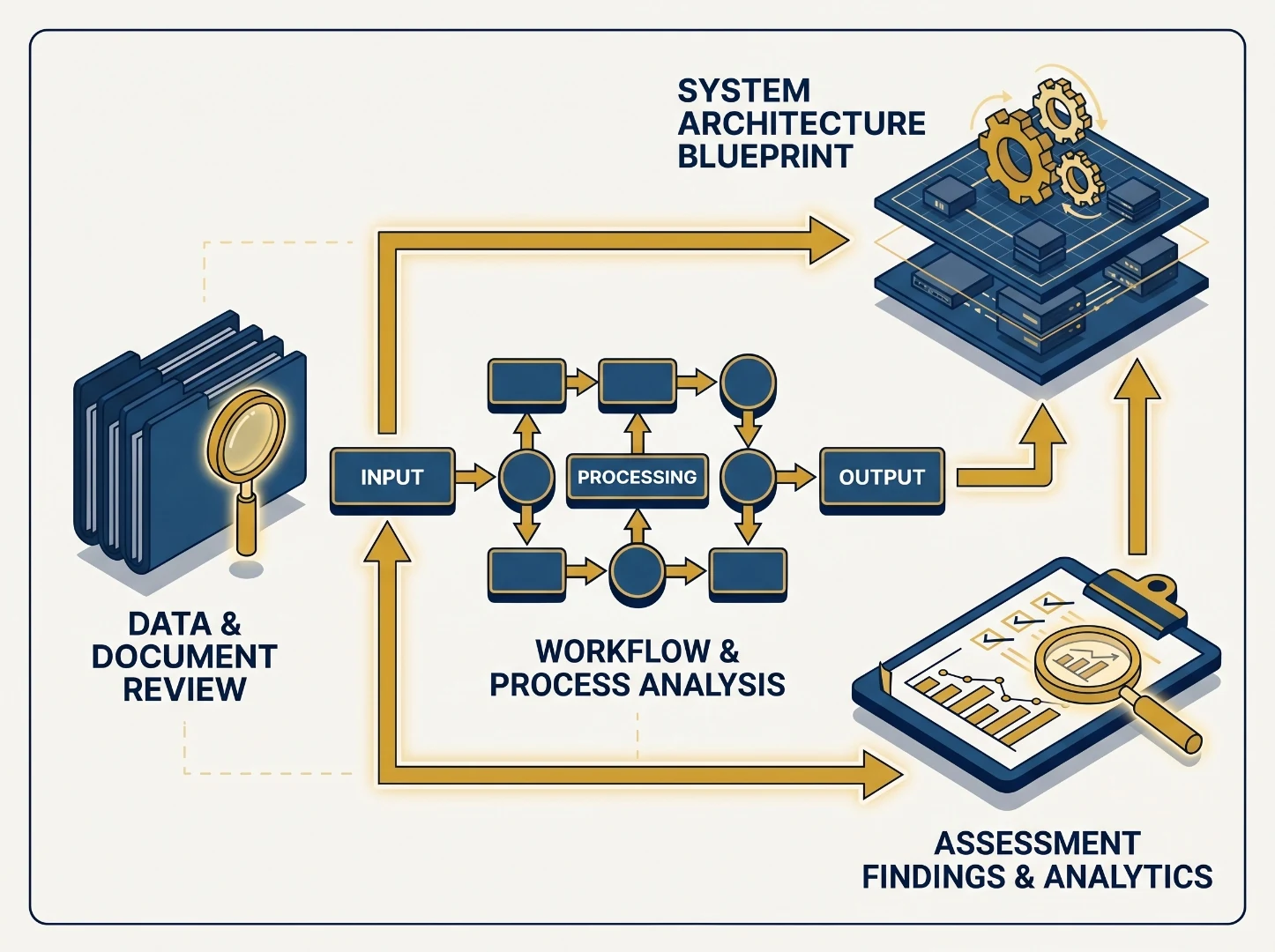
Phase 0 · Assess runs as four parallel workstreams over two to five weeks. They feed each other, and they converge in a single readout to the executive team and board.
Leadership interviews
We sit down with the executive team, one at a time, and ask them what they actually do, what they wish they didn't have to do, and where the work breaks. These are working sessions, not surveys. The point is to surface the operational reality behind the org chart — what decisions get made where, what information those decisions depend on, and where the friction lives. We come out of this with a working model of how the business actually runs, which is rarely the same as how it's described.
Operational mapping
In parallel, we map the workflows that matter — the ones tied to revenue, to delivery, to risk. We trace them end to end: who touches the work, what systems they touch, where handoffs happen, where things stall. This is the layer that determines what AI can plausibly help with and what it can't. Most AI engagements skip this and end up automating the wrong steps.
Data audit
This is the centerpiece of Phase 0 · Assess, and the part most assessments either skip or treat as a footnote. We do a full inventory of the company's data estate — what data exists, where it lives, what shape it's in, and how fit it is for the kind of AI work the company is considering. We look at the systems, the file shares, the databases, the SharePoint sites, the recordings, the tickets, the inbox archives, the ERP, the CRM, and the things that don't sit anywhere in particular. We assess cleanliness, structure, access, and AI-readiness on a source-by-source basis. The output is the map every downstream decision depends on.
Synthesis and recommendations
We pull the three streams together into a single document and a single readout. Recommendations are sequenced — what to do first, what to defer, what to retire, what to consolidate. We are explicit about what we are confident in and what we are not. The deliverable is built to be readable by a board and actionable by an executive team in the same sitting.
What the data audit covers
The data audit is the part of Phase 0 that produces the most durable artifact. It is also the part that tends to surface things the company has been quietly carrying for years. We look at:
- Data inventory. What data the company actually has, broken down by domain. What's tracked, what's missing, what's duplicated across systems, what's been collected but never used.
- File and content types. Documents, spreadsheets, slide decks, contracts, call recordings, transcripts, support tickets, CRM records, ERP tables, email archives, knowledge base content, code, logs. Structured and unstructured, both.
- Storage and access architecture. Where it lives — cloud, on-prem, SaaS, file shares, SharePoint, Drive, Dropbox, individual laptops. Who has access. How access is granted, revoked, and audited. Where the seams are.
- Cleanliness and structure. What state the data is in. What naming conventions exist or don't. What's tagged, what's orphaned, what's versioned, what's not. What would need to be cleansed, restructured, or re-tagged before an AI system could use it without producing nonsense.
- AI-readiness, source by source. For each meaningful source, an honest assessment of how usable it is for retrieval, for fine-tuning, for agent workflows, or for analytics. Some sources are ready. Some need work. Some should be left alone.
The audit is delivered as a structured map, not a narrative. It is meant to be referenced for the next eighteen months, not read once and shelved.
Every AI build that skips discovery ends up doing it later. Whether you run it or we do, run it before the build.
What you walk away with
A Phase 0 · Assess engagement produces a set of artifacts designed to be used, not admired:
- Data estate map. A structured inventory of every meaningful data source, with location, type, owner, and AI-readiness scored consistently across sources.
- Prioritized workstream sequencing. A recommended order of operations for the first twelve months of AI work, with reasoning attached to each recommendation.
- Build vs. buy guidance. Per workstream, where to build internally, where to use a vendor, and where to wait.
- Partition architecture sketch. An early-form picture of how data, agents, and workflows should be partitioned across the business — the scaffolding Phase 1 builds against.
- Recommended Phase 1 scope. A concrete, scoped proposal for the first build engagement, sized to what the data estate can actually support.
- Risk and governance notes. What needs to be addressed on the legal, security, and access-control side before AI systems touch production data.
- Executive readout. A single document and a live session built to land with both the board and the operating team.
When to hire us for it, and when not to
A serious AI program cannot start downstream of discovery. Whether that discovery is yours or ours matters far less than whether it happened. Three things consistently go wrong when the stage is skipped entirely:
- Sunk-cost data work. A platform gets picked and a build kicks off — then six months in, the team discovers the data is in worse shape than anyone realized. The data work that should have happened first happens anyway, under deadline pressure.
- Public commitments before facts. Direction gets announced to the board before the executive team has an honest picture of the data estate. Course-correcting later is politically expensive.
- Worse, slower, more expensive outcomes. Companies that do the discovery first look coherent eighteen months in. The ones that skip it quietly rebuild their data estate while pretending the original plan is still on track.
Phase 0 · Assess is the version where we do that work with you, before the contracts get signed and before the executive team has publicly committed to a direction.
Hire us for it when: the executive team disagrees about where the friction is; nobody has inventoried the data estate; the board wants an independent view before capital is committed; a vendor decision is imminent and the case for it rests on assumptions about the data.
Bring your own when: leadership already agrees on the two or three processes worth fixing; you have a recent audit or a consultant's roadmap; you have pilots with lessons attached. In that case, Pilot Build is the door.
Timeline and engagement model
Phase 0 · Assess runs two to five weeks, depending on the size and complexity of the data estate. A typical engagement includes:
- 12–20 leadership interviews, scheduled across the first two to three weeks
- Working sessions with the data team and IT — typically three to five touchpoints, sized to what the environment requires
- Source-level review of the major systems, conducted with the people who actually use them
- A mid-engagement check-in with the CEO and, where appropriate, the board sponsor, to surface anything that needs to be addressed before final synthesis
- A final readout to the executive team and the board, delivered as a written document plus a live session
We work on-site or remote depending on what the engagement calls for. Most engagements are a mix.
Pricing
$45,000–$65,000 · 2–5 weeks
Scope-driven within the band. Where an engagement lands depends on the size of the executive team being interviewed, the number and complexity of the systems in scope for the data audit, and whether the engagement includes a board-level readout on top of the executive readout. We will be specific about scope and price before any commitment.
Request a Phase 0 conversation
If you are the CEO or a board member thinking seriously about where to start, the next step is a conversation, not a proposal. We will talk about the business, the systems, and what a Phase 0 · Assess engagement would look like in your environment. If it is not the right time, we will say so. And if you have already done this work, bring us the output. Pilot Build is built for exactly that conversation.
Request a Phase 0 conversation →