1
Step 1 — Decompose
Take every role on a team and break it into discrete tasks. Not job descriptions — actual tasks people do, sized in roughly 15-minute units. A typical mid-level role decomposes to 30–50 tasks.

A BuildClub methodology
The proprietary framework BuildClub uses in Phase 2 of the BuildClub Method to deploy AI agents without replacing people. Decompose. Cluster. Deploy.
In plain English
We don't automate a whole job at once. We break the job into repeatable task clusters, automate the clusters that are ready, and leave judgment-heavy exceptions with the people who already handle them well.
The Task Cluster Method™ is the agent deployment framework BuildClub uses in Phase 2 of the BuildClub Method. It exists to answer one question: when you want to deploy AI agents inside a real business, what do you deploy them on?
Most AI consultancies promise to deploy agents on jobs. It's the wrong unit of work.
Jobs are too varied. A senior AP analyst doesn't do one thing — she reconciles spreadsheets, fields vendor inquiries, processes exceptions, prepares month-end accruals, and trains new hires. No single agent can do all of that well. So single-agent-replaces-job deployments either fail outright, or get scoped so narrowly that the productivity gains are theoretical.
We don't deploy agents on jobs. We deploy agents on task clusters.
The method
Take every role on a team and break it into discrete tasks. Not job descriptions — actual tasks people do, sized in roughly 15-minute units. A typical mid-level role decomposes to 30–50 tasks.
Group tasks across people and across teams, by type and process. The AP analyst, the controller, and the FP&A manager all reconcile spreadsheets — those tasks cluster. The same is true for vendor follow-up, document classification, exception research, and dozens of other patterns.
Build one agent per cluster. Scope it tight. Monitor it. Keep humans in the loop. The agent takes over the cluster end-to-end; the humans keep their jobs and get the time back.
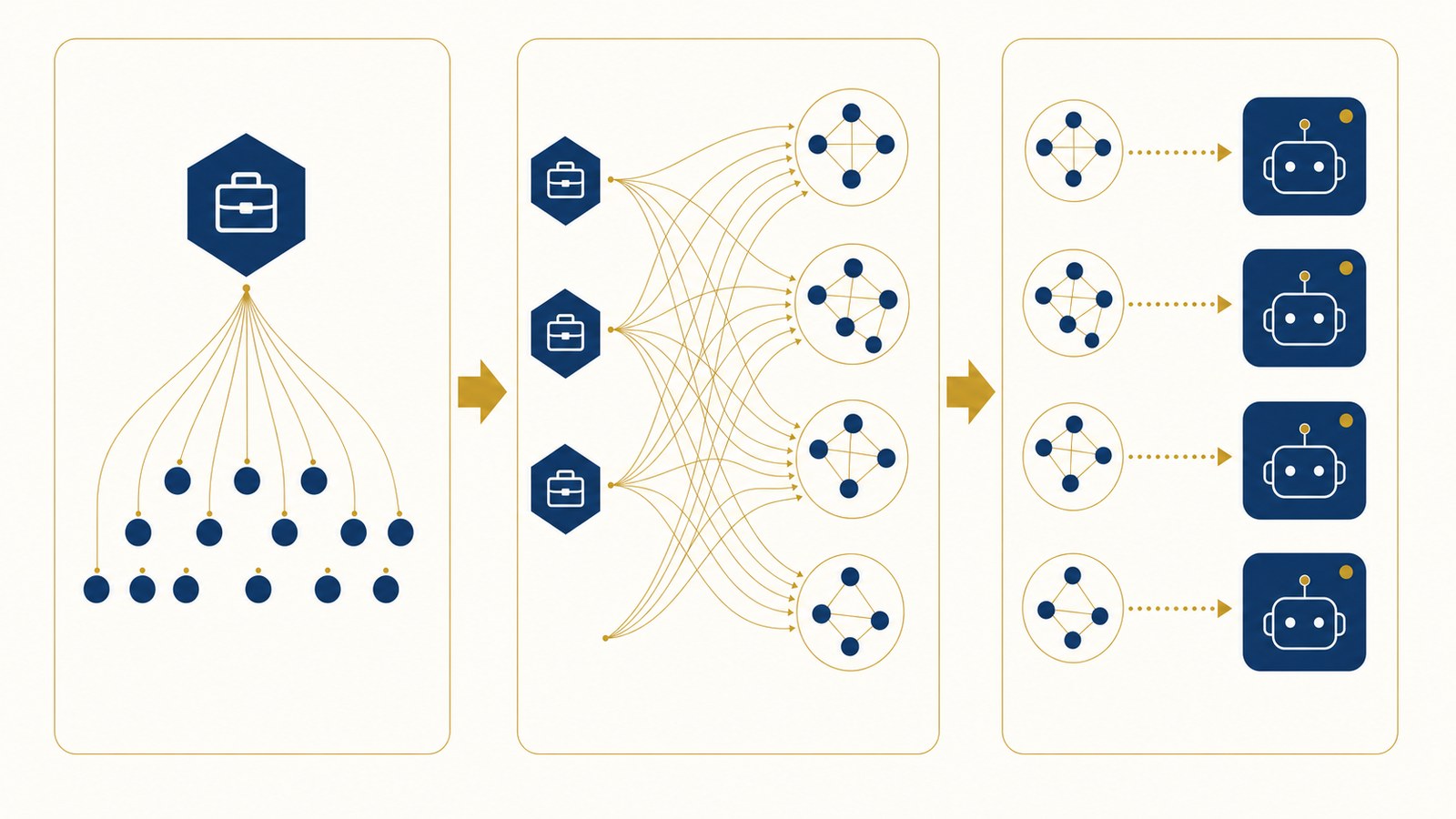
The Task Cluster Method™ — Decompose → Cluster → Deploy
Worked example
Take a typical mid-market AP function. Three roles: the AP analyst, the controller, the FP&A manager.
When we decompose, we typically find each role has 30–50 discrete tasks across the week.
When we cluster, recurring patterns surface. One of the strongest is spreadsheet reconciliation — the AP analyst spends roughly 8 hours a week on it, the controller spends 4, the FP&A manager spends 3. Across the three roles, that's 15 hours a week in one cluster.
When we deploy, we build one reconciliation agent — scoped tight to the specific spreadsheet patterns and data sources these three people use, with monitoring, fallback to a human-in-the-loop, and a clear escalation path for exceptions.
Outcome: most of those 15 hours come back — roughly an eighth of the three roles' combined week. The AP team keeps their jobs. The cluster gets done faster, more consistently, and at a fraction of the variable cost. And once the first cluster is live, the next one — vendor follow-up, or exception research, or document classification — is already in design.
Principle 1
By replacing tasks (not jobs), we preserve the human roles that drive judgment, relationships, and exception handling. The team gets time back; nobody loses their seat.
Principle 2
Each agent is built for one cluster. That makes them faster to ship, easier to monitor, and more reliable in production than the "do-everything" agents that get promised and rarely delivered.
Principle 3
Once the first cluster is live, the methodology runs continuously. New clusters surface as the team uses the system. Phase 2 isn't a project that ends — it's a deployment loop that expands.
The Task Cluster Method™ is what we do in Phase 2 of the BuildClub Method. The starting point is a structured view of which clusters to attack first. If you have one, bring it. If you do not, Phase 0 · Assess builds it.