Layer 1 — Frontend
Claude, Copilot, ChatGPT, or a custom UI — whichever AI tools your team already uses. The Company Brain integrates with them; your team doesn't change tools.

A BUILDCLUB PRODUCT
A standalone, access-segmented knowledge layer for internal retrieval — hybrid graph + RAG under the hood — that ingests from every channel your institutional knowledge already lives in. Deployed inside your own cloud tenant. Separately scoped from the Phase 0 / 1 / 2 path.
Request a conversation →Company Brain is a standalone product — separately scoped from the Phase 0 / 1 / 2 path. It can be delivered alongside Phase 1 · Amplify when scoped that way, but it is not a Phase 1 deliverable and is not bundled into the Amplify flat rate. Engage it whenever your organization is ready for a structured internal-retrieval layer.
At its simplest: a standalone knowledge layer for internal retrieval — built so the AI tools your team already uses (Claude, Copilot, ChatGPT) can answer questions about your business from your actual documents, conversations, and process knowledge instead of guessing. We call it Company Brain. Under the hood it is an access-segmented, hybrid graph + RAG backend that pulls from the channels you already use — meeting transcripts, email, Teams and Slack messages, documents, spreadsheets, presentations.
When your executives ask Claude (or Copilot, or whichever AI tool they already use) a question about your business, the answer is grounded in your actual institutional knowledge. Not the public internet. Not a generic model. Your company.
Four layers, each with a defined role.
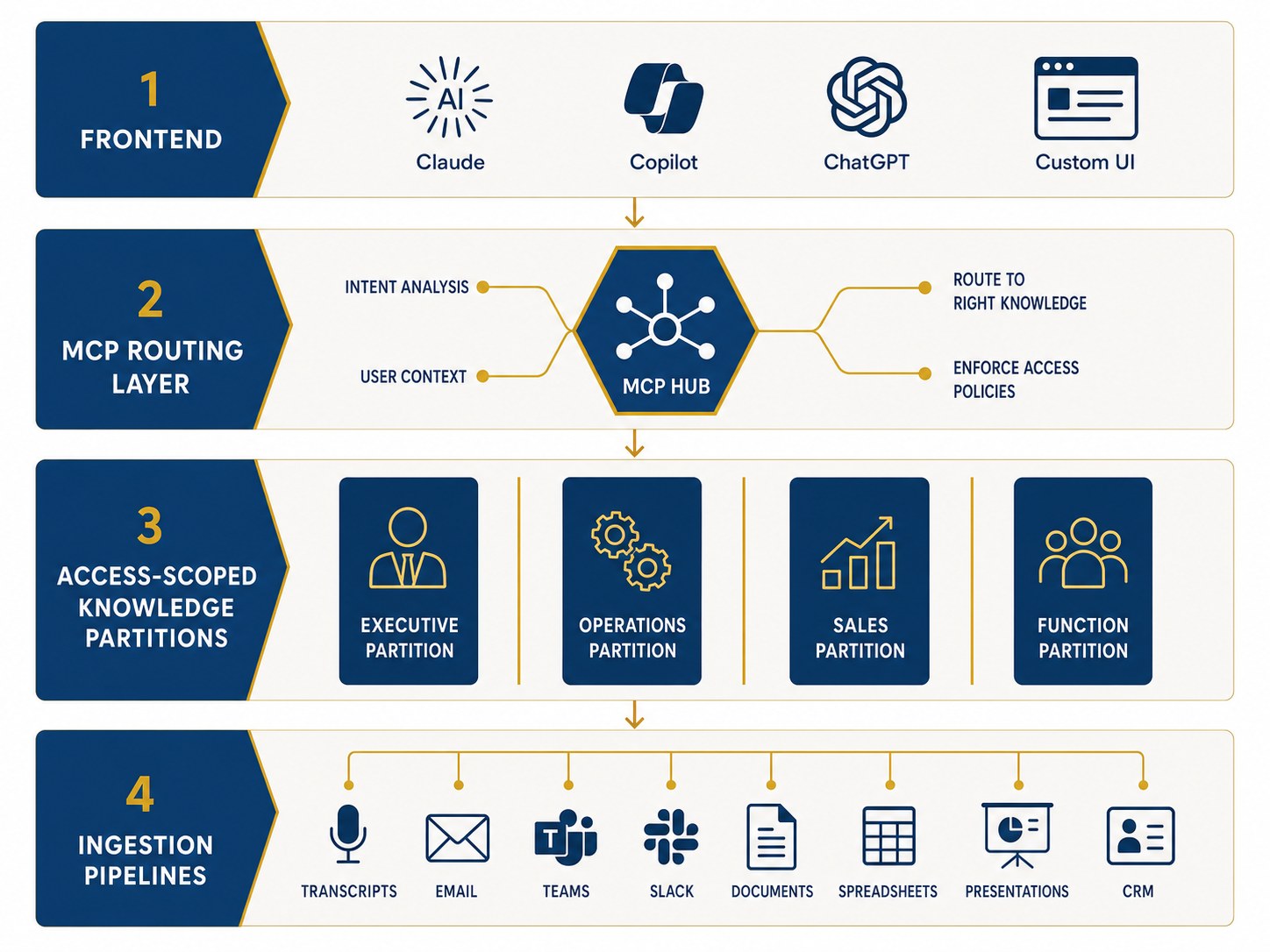
Claude, Copilot, ChatGPT, or a custom UI — whichever AI tools your team already uses. The Company Brain integrates with them; your team doesn't change tools.
Routes each query to the right data source — graph or RAG — and enforces which knowledge partition answers. This is the layer that keeps the executive brain separate from the operations brain.
Not everyone sees everything. Your C-suite brain has access to the full corpus. Your operations brain sees customer and ops materials but not HR strategy. Your sales brain sees pricing history and opportunity data but not financial planning. Each partition is logically isolated.
Connectors that pull from every source where your institutional knowledge lives: meeting transcripts, email, chat, documents, spreadsheets, presentations, CRM, and custom systems. New sources come online as the system matures.
Not everyone in your company should see everything. So we don't build one brain — we build a set of access-scoped instances, each with its own corpus.
Your C-suite brain has access to the full corpus: every document, every transcript, every conversation. Your operations brain has access to customer-related materials but not HR strategy. Your sales brain has access to opportunity history and pricing logic but not financial planning. Each brain is logically isolated — there is no data leakage between partitions.
When a user queries through Claude or Copilot, the routing layer enforces the partition automatically. The user only sees what they're authorized to see. There is no manual permissioning to maintain per-query.
Typical ingestion sources, with examples of what each one powers.
| Source | Examples | What it powers |
|---|---|---|
| Meeting transcripts | Zoom, Teams, Fireflies, Gong | "What did we decide about pricing in Q2?" |
| Microsoft 365, Google Workspace | "Show me every commitment we made to this client" | |
| Chat | Teams, Slack | "What's the latest thinking on the renewal strategy?" |
| Documents | SharePoint, Google Drive, Notion, Confluence | "Find the SOC 2 evidence pack from last cycle" |
| Spreadsheets | Excel, Google Sheets | "What was our actual margin on this product line in 2025?" |
| Presentations | PowerPoint, Google Slides, Keynote | "What slides have we used to explain our methodology to investors?" |
| CRM | Salesforce, HubSpot | "What's our history with this account?" |
| Custom | Anything with an API or export | Industry-specific systems, proprietary tools |
Meeting transcripts
Zoom, Teams, Fireflies, Gong
"What did we decide about pricing in Q2?"
Microsoft 365, Google Workspace
"Show me every commitment we made to this client"
Chat
Teams, Slack
"What's the latest thinking on the renewal strategy?"
Documents
SharePoint, Google Drive, Notion, Confluence
"Find the SOC 2 evidence pack from last cycle"
Spreadsheets
Excel, Google Sheets
"What was our actual margin on this product line in 2025?"
Presentations
PowerPoint, Google Slides, Keynote
"What slides have we used to explain our methodology to investors?"
CRM
Salesforce, HubSpot
"What's our history with this account?"
Custom
Anything with an API or export
Industry-specific systems, proprietary tools
Most clients start with one or two sources — usually documents and one communication channel. As trust grows and the system proves itself, new pipelines come online: meeting transcripts after the team gets comfortable, CRM data once governance is set, financial spreadsheets once the access partitions are validated.
A typical trajectory: v1 ships with 2–3 sources at 90 days. v3 might have 10–15 sources at 18 months. The Company Brain compounds.
Every deployment is in-tenant. The shape of it, which tenant and which region, is decided in scoping before build work begins.
The Company Brain lives inside your AWS, Azure, GCP, or on-premises environment. BuildClub operates credentialed inside it. Your data does not leave your compliance boundary. This is the standard deployment for every engagement.
The same in-tenant architecture, in an account you own, constrained to a specified national cloud region with no cross-border data flow. For defense-adjacent work, regulated industries in specific jurisdictions, and certain public-sector deployments.
The deployment is shaped alongside the data audit and operational mapping, yours or ours, so the architecture is explicit before build work begins. See the full security model →
“You own it. Fully.”
The Company Brain, the data, the model weights and embeddings, and the access controls all sit inside your environment — your tenant, or a sovereign region in an account you own. BuildClub builds it; you own it. We do not retain a copy of your data, train models on your data, or operate the Company Brain as a service we could withdraw.
INVESTMENT
$80K–$120K
scoped to source count and partition complexity
Ongoing operations scoped per engagement, typically a monthly fee covering pipeline maintenance, model updates, and new source ingestion.
Request a conversation →Company Brain can be delivered alongside an Amplify engagement when scoped, but it is a standalone product with its own pricing — it is not bundled into the Amplify flat-rate fee by default.
See Phase 1 · Amplify →Engage it without Phase 1 or any other engagement. Common for clients who already have AI tools rolled out but lack a unified knowledge backend.
Agents in Phase 2 query the Company Brain for context. A mature Company Brain makes Phase 2 dramatically faster and more accurate.
See Phase 2 · Workforce →CASE STUDIES
Three composite examples, each pitched at the level of an engagement type rather than a single client. Different partition structures, different integration points, different outcome shapes.
PEOs
Four access-scoped partitions across compliance, benefits, payroll, and CSM functions. The leverage layer that lets a PEO service team hold flat while WSEs scale.
Read the case study →Healthcare
Credentialing, RCM, and prior auth all draw on the same payer corpus through partition-scoped access. The same knowledge serves multiple teams without violating HIPAA or internal scoping.
Read the case study →Technology / SaaS
Salesforce, the CS platform, conversation intelligence, and support history connected into one queryable layer. CRM activity logging coverage moves from roughly 40% to near 100% as a side effect.
Read the case study →Start with a discovery call. We'll scope the engagement, map the tenant architecture, and identify your first ingestion sources.
Request a conversation →