
Client Background
A mid-sized waste and recycling operator was trapped in a familiar loop:
- A customer said their cart or can was missed.
- A driver insisted it was serviced.
- A supervisor needed proof.
- The city demanded documentation.
Everyone burned time chasing partial photos, incomplete GPS logs, and fuzzy memories.
The company served close to 30,000 customers across multiple municipal contracts, including hundreds of commercial accounts and a dense residential route. Disputes were a tax on the business: avoidable trips, frustrated CSRs, hostile city meetings, and erosion of trust.
The Problem
Three pain points kept compounding:
- Disputed pickups. "You missed my can" was a daily refrain. The operator could not always prove a service had happened.
- Hours of CSR adjudication. Customer service reps would replay calls, look at GPS pings, and call dispatch — guessing at what had really happened.
- Contract risk. Municipal contracts increasingly required documented proof of service. "We think we did it" was no longer good enough.
Existing commercial systems were either ten years out of date, blindingly expensive (six figures of capex), or both.
What They Needed
The operator wanted a system that would:
- Capture every stop with usable video. Not blurry, not partial — actual evidence.
- Tie video automatically to the address being serviced. No driver tagging, no manual review.
- Make it easy for CSRs and supervisors to look up a service in seconds.
- Cost something defensible per truck. A $50K box on every cab was a non-starter.
It also needed to be technician-installable. The fleet team didn't want to send trucks to a third-party vendor for retrofits. They wanted parts in a kit, plug-in install, done.
Why They Engaged BuildClub
The operator had already evaluated commercial "telematics with cameras" platforms. Most were locked-in vehicle-management products that bundled features they didn't need at a price they didn't want to pay. None gave them the actual artifact they were after — a queryable, timestamped, address-tagged video record.
BuildClub Professional Services proposed something different: assemble the right commodity hardware, glue it together with thoughtful software, and let the operator's own technicians install and maintain it.
The pitch was concrete:
- Raspberry Pi–based capture device per cab
- 360° camera mounted to the upper body of the truck
- GPS dongle
- 4G modem for periodic uploads
- A small cloud backend that automatically tied video segments to the addresses serviced
No proprietary lock-in. Replaceable parts at every level.
The MVP Stack
For the proof-of-concept truck, the build looked like this:
- Capture device: Raspberry Pi 4 (8 GB) inside a ruggedized case in the cab
- Camera: A 360° automotive-grade unit mounted to the upper rear of the truck body, looking down and back at the lift area
- GPS: A USB GNSS dongle delivering 1 Hz location
- Cellular: A 4G hotspot with a dedicated SIM, talking to a tiny FastAPI service in the cloud
- Storage: Local SD card with rolling buffer, plus an SSD for finalized clips before upload
Cost per truck for hardware came in well under $1,500, and the recurring cellular plan was a rounding error against existing fleet telematics spend.
How the Solution Works
The Pi runs a small set of services on boot:
- A capture loop that records continuous video to a rolling buffer.
- A stop detector that watches GPS speed and idle time. When the truck stops at a known route address (or near one), it tags the time window and writes a short clip with a few seconds of pre- and post-roll.
- An address resolver that maps the GPS coordinates of each tagged clip to the route's address list. Coordinates are matched with a simple proximity threshold tuned for the truck's actual stopping pattern.
- An uploader that batches finalized clips and pushes them to a cloud bucket whenever the truck has a strong enough signal — usually back at the yard.
In the cloud:
- Clips are written to object storage with a clean naming convention: route/date/sequence/address.mp4.
- A small Postgres table indexes everything: route, truck, driver, address, timestamp, clip URL.
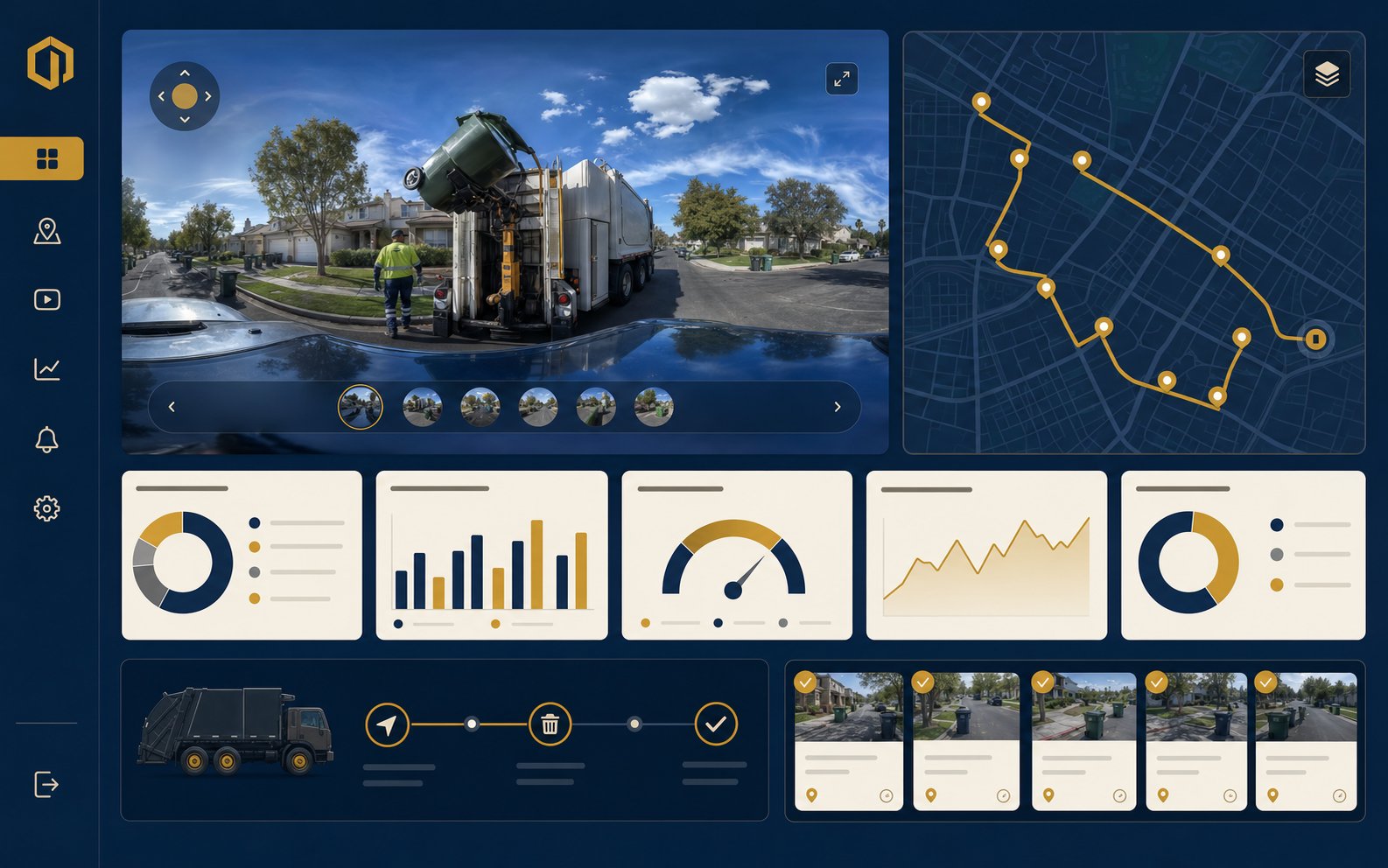
- A web app for CSRs lets them search by address and date, see the clip in seconds, and resolve disputes without calling dispatch.
A disputed pickup that used to take 15–30 minutes of detective work is now a 30-second lookup.
The CSR Portal
The CSR-facing app is intentionally narrow:
- A search box (address + date)
- A list of matches
- A video player
- A button to mark the case resolved with a one-line note
No dashboards. No "AI insights." Just the clip, the timestamp, and the resolution flow.
The operator's CSRs were trained in under an hour. Average dispute-resolution time dropped from ~22 minutes to under 2.
Hardware: Designed for In-House Install
BuildClub deliberately picked components a fleet technician could install:
- One USB-powered Pi enclosure mounted under the dash with a single fused power tap
- One coaxial run from cab to upper rear body for the 360° camera
- One USB GPS
- One mini PC enclosure for the 4G modem
No welding, no proprietary harness, no "only authorized installers." The first 6 trucks were retrofitted by the fleet's own technicians using a one-page wiring diagram BuildClub produced during the build.
Results
After the first quarter on a 12-truck pilot, the operator reported:
- Disputed-pickup workload down ~70%. Most disputes are now resolved in the first call.
- Hours of CSR adjudication removed per week: ~20.
- Customer experience improvement measurable in NPS, complaint volume, and city contract reviews.
- A defensible artifact for every contract review. "Here's the video."
More importantly, the operator owned the system. Hardware was off-the-shelf, the software was theirs, and the cost-per-truck was a fraction of any commercial alternative.
Final Thought
The right answer to a fleet documentation problem wasn't a six-figure platform. It was a $1,500 box per truck, a clear data model, and a CSR portal that did exactly one thing well. BuildClub's job was to assemble it, install it cleanly, and walk away leaving the operator able to maintain and extend it themselves.
Want help with something similar? Talk to us →
We work with operators, PE-backed businesses, and professional services firms to ship outcomes — not decks.