
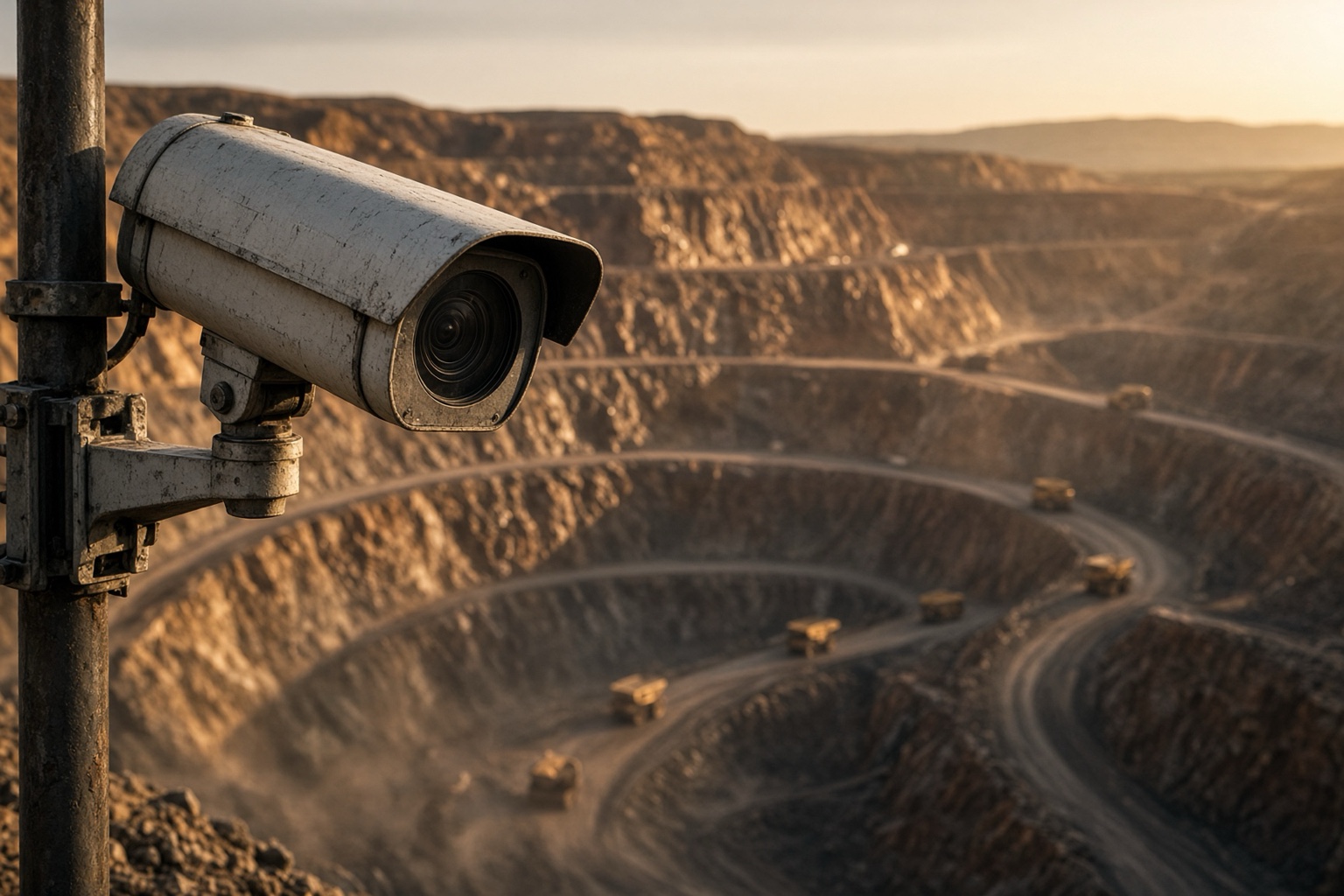
The reporting chain is long. The cameras are live.
Ask a mine owner how last month went and they will read you the monthly pack: tonnes moved, grade delivered, plant availability, cost per tonne. Ask how they know, and the honest answer is a chain of custody that starts with a supervisor keying shift numbers into a daily report, which gets aggregated into a weekly summary, which gets packaged into the monthly pack. Three hops, each losing detail and adding delay. By the time a shortfall is visible at board level, the quarter that produced it is gone.
Meanwhile, on the same site, cameras cover the pit, the ROM pad, the crusher, the conveyors, and the plant floor. They were installed for security and safety, and they run around the clock. They see every dig cycle, every haul cycle, every load count, every shift start. They see the blocked conveyor at 2 a.m. and the excavator that sat idle through a shift change.
They watch everything. They tell no one.
The gap between reported and observable
Every operation has two versions of itself: the one in the reports and the one on the ground. The distance between them is not usually dishonesty — it is aggregation, delay, and the limits of what a person can key into a form at the end of a twelve-hour shift. But that distance is exactly where value leaks: cycle times that drift, fill factors that erode, utilization that is known anecdotally rather than measured, shift starts that slip fifteen minutes a side.
The math is unforgiving in mining because the denominators are enormous. A single operational improvement at a single site — a point of utilization, a fraction of a fill factor — is routinely worth seven or eight figures a year. Which means the gap between reported and observable is not a reporting nuisance. It is one of the largest unpriced line items on the property.
This is a data-collection project, not a capex program
Here is the part that has changed. Reading camera feeds used to mean either hiring people to watch monitors or buying a proprietary hardware-and-analytics stack from a vendor. Neither scaled. Computer vision on existing CCTV now does: level checks on dig and haul cycles, load counts, belt state, blockage detection, activity at shift boundaries — running on the cameras the site already owns.
That reframes the whole question. Standing up an operational-truth layer is not a fleet replacement or a sensor rollout. It is a data-collection project on infrastructure that is already bought, mounted, and powered. The output is simple and pointed: a reconciliation of what the cameras observed against what the shift reported, and an alert when something the cameras can see — a stopped belt, an idle loader, a late start — deserves attention now rather than at the weekly meeting.
Why it usually does not happen
If the infrastructure exists and the technology works, why does the gap persist? Because the market is organized around selling boxes. Camera-analytics vendors sell their cameras, their platform, their subscription. Fleet-system vendors sell their telemetry as the single source of truth. Every pitch arrives with a demo and a case study, and every pitch ends with the owner buying another system that holds its own version of the data.
Owners do not need another box. They need someone on their side of the table: to write the specification from the site's actual workflows, run the bake-off on the site's own footage, negotiate who owns the data and the models trained on it, and manage the deployment inside the owner's tenant. When the evaluator holds no reseller agreements and takes no commissions, "this tool is not ready" is an available answer. That independence is what makes the resulting numbers trustworthy — including to your board, your lenders, and eventually a buyer.
What good looks like
A working operational-truth layer is unglamorous and specific. Observed dig and haul cycles reconciled daily against reported production, with the variances flagged rather than buried. Load counts checked against the fleet system, not to replace it but to verify it. Real-time alerts for the handful of deviations the cameras can already see — blocked conveyors, idle equipment, missed shift starts. And one new column in the monthly pack: what the site reported, next to what was observed.
Nothing in that list replaces an operator, a fleet system, or a site GM's judgment. The cameras do not run the mine. They tell the owner the truth about it, continuously, from infrastructure that was already paid for.
Your cameras already know. The only question is whether anyone is listening.
Want an independent read on what your site's cameras could be telling you? Talk to us →
BuildClub is the owner's representative for AI in mining — vendor-neutral, in your own tenant, with no reseller agreements and no commissions. Phase 0 · Assess is the usual starting point.